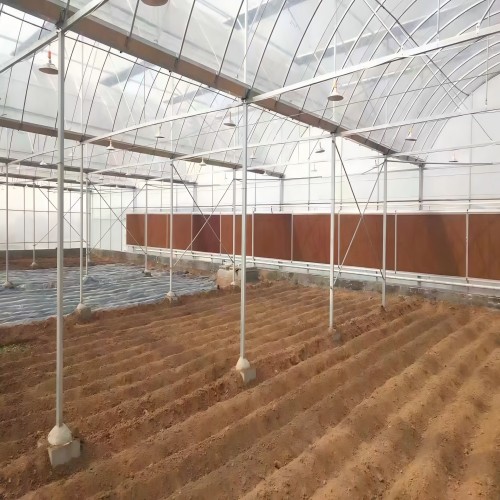
Multi-span glass greenhouses, as an essential component of modern agricultural facilities, play a significant role in improving crop yield and quality. However, balancing ventilation and insulation has always been a major challenge for growers. How to ensure a suitable temperature inside the greenhouse while maintaining effective ventilation is a key issue in greenhouse design and management. This article explores how multi-span glass greenhouses can achieve both ventilation and insulation, focusing on structural design, environmental control technologies, and management strategies.
I. Structural Design for Balancing Ventilation and Insulation
1.Roof Design
The roof design of a multi-span glass greenhouse directly affects ventilation and insulation. Common roof types include gable, arched, and flat roofs. Gable roofs facilitate rapid rainwater drainage and allow natural ventilation through roof vents. Arched roofs distribute sunlight more evenly, reducing localized overheating. Flat roofs, while structurally simple, are less effective in ventilation and insulation. To balance both, gable or arched roofs with adjustable vent systems are recommended.
2.Side Vents and Roof Ventilation Systems
Side vents and roof vents are the primary means of greenhouse ventilation. Side vents, typically located on the greenhouse walls, allow outside air to enter, while roof vents expel hot air. To maintain insulation, these vents should have good sealing properties to prevent heat loss when closed. Additionally, the opening angle and speed of roof vents should be adjusted based on indoor-outdoor temperature differences and crop needs for optimal ventilation.
3.Double-Glazing or Insulation Films
To enhance insulation, double-glazed glass or insulation films can be used. The air layer between double-glazed panels reduces heat loss while maintaining high light transmittance. Insulation films can be applied externally during cold seasons to further minimize heat dissipation. These measures improve insulation without significantly compromising ventilation.
II. Application of Environmental Control Technologies
1.Automated Ventilation Systems
Automated ventilation systems adjust roof and side vents based on real-time parameters such as indoor/outdoor temperature, humidity, and CO₂ levels. For example, when indoor temperatures rise, the system opens vents to promote airflow; when temperatures drop, it closes them to retain heat. This intelligent management improves ventilation efficiency while reducing energy consumption.
2.Shading and Thermal Curtains
Shading and thermal curtains are crucial for environmental control. Shading curtains reduce heat buildup and protect crops from excessive sunlight in summer, while thermal curtains retain heat during cold nights or winter. Proper use of these curtains helps balance ventilation and insulation across different seasons.
3.Underfloor Heating and Hot Air Systems
In cold seasons, underfloor heating warms the greenhouse by heating the ground, minimizing heat loss from air movement. Hot air systems distribute warm air evenly via ducts, ensuring a stable growing environment. These heating systems can work in tandem with ventilation to maintain airflow without sacrificing warmth.
III. Optimization of Management Strategies
1.Seasonal Adjustments
Greenhouse management should adapt to seasonal changes. In summer, increased venting frequency and shading curtains help lower temperatures. In winter, closing unnecessary vents, deploying thermal curtains, and activating heating systems maintain warmth.
2.Crop-Specific Requirements
Different crops have varying temperature and ventilation needs. Leafy greens require more ventilation, while fruiting crops prioritize stable temperatures. Management strategies should align with crop characteristics—e.g., increasing ventilation for leafy greens and prioritizing temperature control for fruiting plants
3.Energy Efficiency Balance
Balancing ventilation and insulation must also consider energy consumption. Over-reliance on heating increases energy use, while excessive ventilation leads to heat loss. Sustainable solutions like solar collectors or geothermal heat pumps can optimize efficiency while reducing energy costs.
IV. Case Study
A multi-span glass greenhouse in a certain region adopted a gable roof design with automated ventilation and double-glazed panels. In summer, natural ventilation via roof and side vents, combined with shading curtains, maintained optimal temperatures. In winter, closed vents, thermal curtains, and underfloor heating minimized heat loss. This approach achieved year-round balance, significantly boosting crop yield and quality.
V. Conclusion
Balancing ventilation and insulation in multi-span glass greenhouses requires a systematic approach integrating structural design, environmental technologies, and adaptive management. Thoughtful design, smart climate control, and optimized strategies ensure ideal growing conditions while enhancing energy efficiency. As technology advances, future solutions will further streamline this balance, supporting sustainable agricultural development.